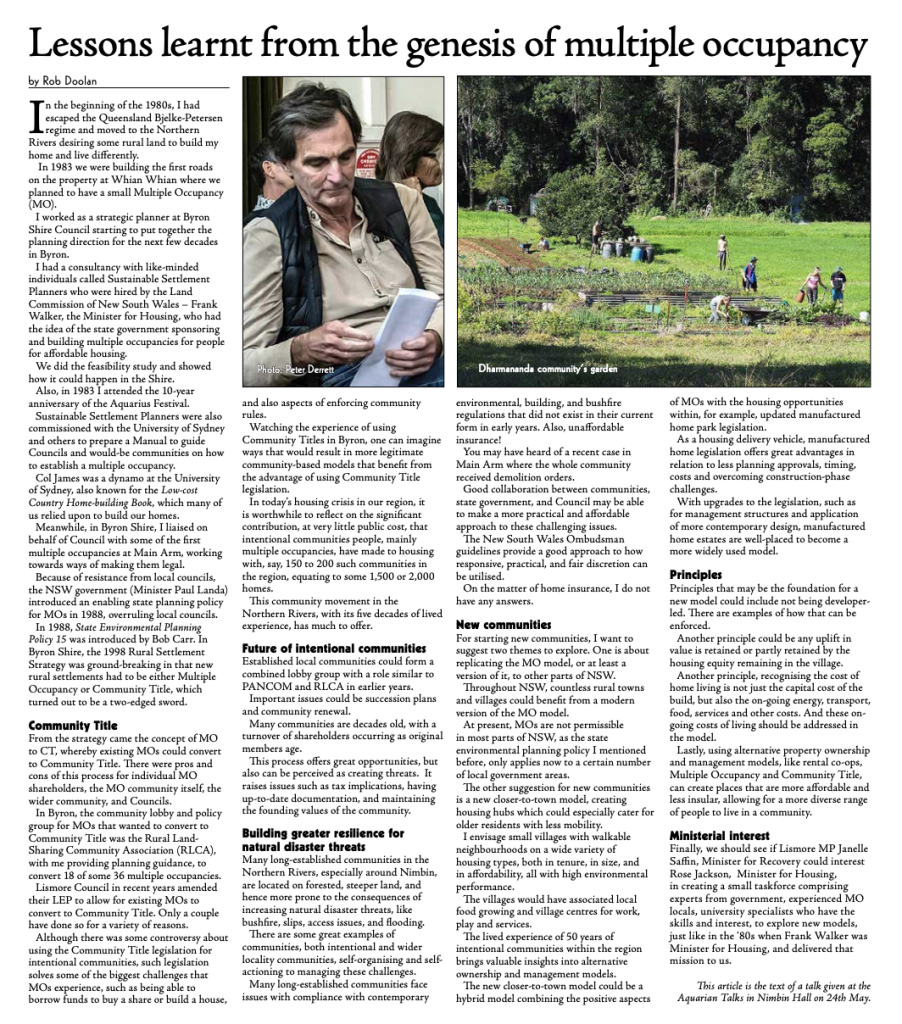

We are grateful for the article that Rob Doolan has written in the Nimbin Good Times in August this year. Rob’s reflections on the development of multiple occupancy (MO) housing in the Northern Rivers region of NSW during the 1980s offer valuable insights for modern communities seeking sustainable, affordable, and collaborative living arrangements. The early experiences of intentional communities, such as the rural MO at Whian Whian, highlight both the challenges and opportunities inherent in creating alternative housing models. Doolan’s dual role as a community developer and strategic planner at Byron Shire Council allowed him to observe firsthand the ways in which local regulations, community aspirations, and state policies intersected, often contentiously, in shaping living spaces.
One key lesson for contemporary communities is the importance of collaboration and relationship-building. Doolan’s work with like-minded individuals, local councils, and state authorities underscores how cooperation and shared vision can overcome initial resistance to innovative housing concepts. Early efforts, including feasibility studies, manuals, and advocacy, were essential in demonstrating the practical and social benefits of multiple occupancies, paving the way for the 1988 introduction of State Environmental Planning Policy 15, which legally recognised these communities despite local objections.
Modern communities can also draw lessons about strategic planning and documentation. By creating structured guides and manuals, early practitioners not only legitimised alternative living arrangements but also made the process replicable for future groups. Today, this emphasises the value of clear frameworks, accessible resources, and knowledge sharing, enabling new communities to navigate planning processes more efficiently.
Another lesson is the integration of social, ecological, and financial planning. Doolan’s experience shows that successful multiple occupancies were not just about housing but about building resilient social networks, shared stewardship of land, and sustainable livelihoods. Modern intentional communities can take inspiration from these holistic principles, combining cooperative governance, ecological restoration, and shared responsibility to create thriving, enduring communities.
Finally, Doolan’s reflections highlight the patience and persistence required to bring alternative housing into mainstream recognition. Change often unfolds slowly, and setbacks are inevitable. Yet with dedication, clear communication, and collaborative problem-solving, communities can achieve lasting impact. For today’s generation, these lessons remain relevant: innovative, sustainable living requires vision, resilience, and a willingness to work across social and institutional boundaries.
By learning from the successes and challenges of the 1980s pioneers, modern communities can build on a foundation of practical experience, creating spaces that are socially connected, ecologically responsible, and adaptable to the needs of future generations.
Read the full article, page 6 http://www.nimbingoodtimes.com/archive/pages2025/aug/NGT-0825-2-9.pdf