• Skip to main content
  • Skip to primary sidebar
  • Skip to footer

Alternative sustainable living solutions

  • Facebook
  • Instagram
  • YouTube

Donate

  • FAQs
  • Contact

education

Ongo: Bringing Nonviolence into daily life

September 8, 2025 by Trudy Juriansz

By Anne Wilson

Ongo (short for Ongoing practice) is a 12-week journey for individuals, couples, and groups to embody nonviolence in daily life — at home, at work, and in community. The course is participant-led, guided step-by-step by The Ongo Book by Catherine Cadden and Jesse Chu. Drawing on decades of teaching mindfulness, Nonviolent Communication (NVC), and nonviolent direct action across six continents, the authors created a resource to help people bring peace, compassion, and wisdom into the messiness of everyday life. As they put it:

“At the end of the day, everyone wants to know how to do it at home, at work, or in their community. We know from our own experience that it’s not easy. Life is messier outside of the workshop or retreat. Without some form of ongoing inspiration, guidance, and support for practicing peace, wisdom, and compassion, most of us default to ways of being that we don’t enjoy.”

The book offers inspiration from nonviolent leaders past and present, practical exercises, and a clear framework for companions and groups to support one another through 12 weeks of practice.

I was first introduced to NVC while living at Goolawah Land-sharing Co-operative near Crescent Head, NSW, where we formed a practice group around Marshall Rosenberg’s book and recordings. Later, my friend and mentor Wendy Haynes gave me The Ongo Book, and in 2020, just before moving to Moora Moora, a close friend and I began the 12-week journey together via phone and video calls. It became a lifeline during the pandemic — helping us connect deeply and providing a supportive framework to meet challenges with more peace and growth.

Like many others, I had found it easy to fall back into habits of judgment and control, even when using the “right words” of NVC. What made Ongo different was the mindfulness element: calming the nervous system before engaging with others, focusing on intention to connect, and building peaceful responses through daily practice. Over time, I found that peaceful communication became more natural and less effortful.

At Moora Moora, interest soon grew into a group of eight people meeting in person and online during lockdowns. To our surprise, the online sessions were just as deep and connective when everyone could see and hear each other clearly. Since then, we’ve completed the 12-week program twice more, and now continue with fortnightly sessions, weaving in related practices and addressing live issues. This ongoing practice has shifted how we meet conflict — moving us from blame and shame toward observing, naming feelings and needs, and building understanding. It’s gradual work, but it gives me hope.

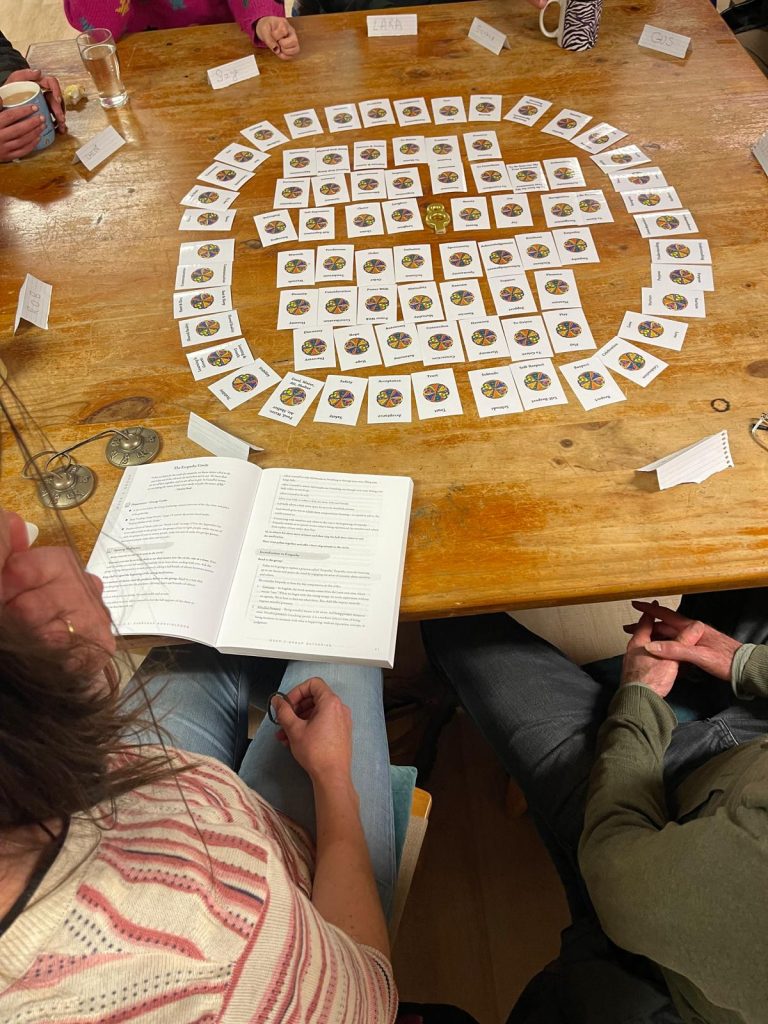
Another gift of Ongo is its accessibility: because the book is so well structured, you don’t need an expert trainer. All it takes is one person to initiate and a few others willing to join, each with a copy of the book. I shared this at the Woven Intentional Communities Conference earlier this year, where members of Narara Ecovillage became curious. When visiting friends there recently, I offered an evening workshop with an Empathy Circle, a core Ongo practice. I was touched by how quickly the group — some of whom had never met — could connect authentically and listen deeply simply by following the guidance in the book. I left heartened that Narara may soon begin their own group.

That experience has inspired me to share Ongo more widely. I’ll be running a free 3-week online introduction to Ongo in the coming months. If you’d like to take part, please reach out at [email protected]To learn more about Moora Moora https://mooramoora.org.au/
Filed Under: cooperative, ecovillage, education, experiential learning, intentional communities, land-sharing communities, projects Tagged With: cooperative, non-violent communication

Living the vision: Narara Ecovillage’s perfectly imperfect path to regenerative living 

September 8, 2025 by Trudy Juriansz

By Tanya Mottl

We’re a group of neighbours on the Central Coast who decided to try something different – to build a place where people, land and future generations can thrive together. Guided by a shared Vision and Mission rather than rigid rules, we use Sociocracy for consent-based decision-making, practise circularity and regeneration, and align our projects with One Planet Living and the UN Sustainable Development Goals. Our monthly Open Days, John Seed’s Deep Ecology workshops and hands-on natural-build, bushfire hazard protection and garden sessions are where new ideas move quickly from conversation to practice.

Because we organise ourselves around inclusion and shared responsibility, things get done without sidelining quieter voices. Sociocracy keeps our meetings practical and respectful; it means decisions reflect the community, not a handful of personalities. When we design homes or run community projects, we aim for solutions that lower waste and long-term costs, support re-localised supply chains, and grow everyone’s skills so resilience isn’t just a word but a day-to-day reality.

That daily reality looks like families playing together, volunteers learning straw-bale or earth-building techniques, and neighbours co-designing emergency plans with lessons from the GEN Resilience Project 2.5 and Keystone Communities. For us, the real benefit is the lived outcome: people belonging to something larger than their household, sharing knowledge and resources, and having practical capacities to cope with shocks – from storm damage to supply disruptions.

We’re still growing – Stage 2 is largely sold and new homes are going up fast – and that momentum matters. More households means a broader mix of ages, skills and perspectives, which strengthens our intergenerational foundation and makes it easier for newcomers to find support and shared infrastructure as soon as they arrive. We welcome prospective families who want to learn, contribute and be part of a practical experiment.

Volunteers come to help on natural builds and in the gardens, taking home skills they can use elsewhere. At the same time, we’re seeking a committed CSA farmer to anchor local food production, enrich our food security, and run educational programs that get kids and adults into the soil. Rising building costs since COVID have made labour-based, community-supported approaches even more important for affordability and training.

We keep track of what we’re learning – impact data, lessons from projects, and the networks we’re part of like AlterCOP and GEN.  We’re taking the momentum from Moora Moora’s Woven Intentional Community Conference into our Nov Before the Tide gathering. Sharing our wins and failures helps other communities adapt faster than we did. We’re not perfect; we’re perfectly imperfect – trying, failing, adjusting and celebrating small wins that add up.

We invite visitors to come to an Open Day, join a workshop, or listen to one of our members’ podcasts. Meet people who are doing the hands-on work of building resilient, connected living. Find upcoming events and more at www.nararaecovillage.com or on Facebook.

Filed Under: ecovillage, education, intentional communities, land-sharing communities, regeneration

Ecovillage Design Intro

July 19, 2021 by Trudy Juriansz

The GEN Australia team organised and facilitated a 1-day workshop at the Quaker House in Brisbane on 17 July 2021. A group of 20 participants came together from various disciplines, representing different new and emerging communities and organisations, with enthusiasm and openness for collaboration and learning and cross-pollination.

The facilitators, Shane Sylvanspring and JJ Blake, use the GEN Ecovillage Design Cards, to take participants on a journey through the ecovillage principles and shared how these principles could be used to enhance their projects and communities. The workshop also introduced the Global Ecovillage Network, the movement and the ecovillages on the ground, as well as tips and guidelines on how to start ecovillages and navigate and set up appropriate legal and financial systems.

Filed Under: education, event, training

Primary Sidebar

Recent News

  • Ongo: Bringing Nonviolence into daily life
  • Afterlee’s next chapter
  • Living the vision: Narara Ecovillage’s perfectly imperfect path to regenerative living 
  • Gulpa Creek Community Farm
  • Balaya Buyul Community – Regenerating land and culture in the Byron Shire

Sign up to be informed on GEN Australia

* = required field

Top Footer

Support GEN Australia

Donating funds to GEN Australia is a tangible way to support a regenerative movement. Your contribution to GEN Australia supports our vision to grow a network of empowered communities, individuals and organisations and helps spread ecovillage solutions more widely.

Join our Newsletter

Subscribe to our newsletter and hear stories from communities and projects in Australia, and hear about the latest news, jobs, opportunities and events from our network.

Volunteer with GEN Australia

There are many ways you can support GEN Australia with our time, energy and skills. We invite you to volunteer with us and deepen your learning and connection with ecovillages and people who share a vision for a positive healthy future.

Footer

WHO WE ARE

  • Our Purpose
  • Governance
  • Our Team
  • Partners
  • FAQs

WHAT WE DO

  • Education
  • Gatherings
  • Ecovillage Transition
  • Networking
  • Projects
  • Consultancy
  • Advocacy

GET INVOLVED

  • Support us
  • Ambassadors
  • Volunteer
  • Stories
  • Newsletter
  • Events

Our Vision

We envision a growing community of empowered communities, individuals and organisations who,  guided and inspired by Australia’s unique, deeply loved nature, collaborate and celebrate whole systems design in regenerating our diverse lands, people, cultures and economies. 

Copyright © 2001–2026, all rights reserved